


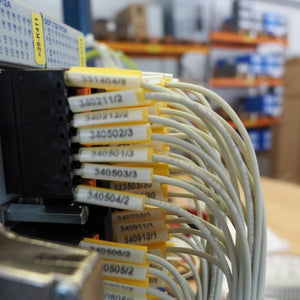

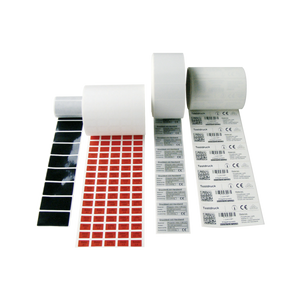


Properly labeling network cables is a key component of standard-compliant and maintenance-friendly IT infrastructure management. Especially in larger corporate networks, data centers, or company-owned server rooms, structured and clearly documented cabling forms the basis for error-free installation, efficient maintenance, and smooth expansion. With Texit's professional printing systems, network cables, patch cables, and installation cables can be labeled permanently, in accordance with standards, and in a machine-readable format—quickly, reliably, and economically.
This label is suitable for network cables
| Solution | Best suited for | Advantages | recommendation |
|---|---|---|---|
| ➡️ KRT-P0 Self-Laminating Cable Labels | Standard-compliant labeling of patch cables and LAN cables in server rooms and IT environments. | Easy to use, durable, and long-lasting, includes a protective laminate | Best-sellers in patch and LAN cables. Our most popular product. |
| ➡️ Cable labels with protective laminate KRT2-P0 | For labeling network cables in high-traffic environments. | Extremely durable, halogen-free material, including a protective laminate | Für anspruchsvolle Umgebungen. |
| ➡️ KFT-V Cable Tabs | Suitable for labeling network cables with larger labels. | Large labeling area | Suitable for larger text, code, or labels. |
Professional network cable labeling
Professional network cable labeling is crucial for the structure, maintainability, and operational reliability of modern IT infrastructures. Whether in a data center, the server room of a medium-sized company, or a traditional office network—professional network cable labeling provides clarity, prevents errors, and reduces downtime.
With Texit cable labeling, you can label patch cables and permanently mark all types of network cables with abrasion-resistant labels that comply with industry standards. Our solutions meet the requirements of internationally recognized standards such as EN 50174 (Parts 1–3), ISO/IEC 14763-2, and ANSI/TIA-606-D—thereby providing maximum security and traceability for any network environment (both during installation and maintenance).
By using self-laminating cable labels, the labeling can be adapted precisely to the cable type and location. This considerably simplifies maintenance, conversions or fault analyses - regardless of whether you are labeling network cables in a single rack or in a large-scale infrastructure.

Our Recommendation for Network Cables
Self-laminating cable labels KRT-P0
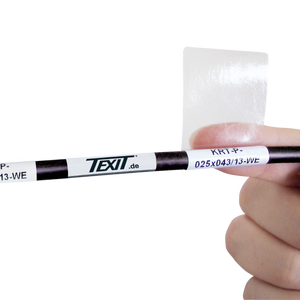
Our self-laminating cable labels are the standard solution for professionally labeling network and patch cables. These labels are extremely durable and space-saving; they can also be used for retroactive labeling, and the protective laminate ensures that the print remains legible over time.
Step 1: Select the right labels
In practice, cable labels and cable flags are the most popular:
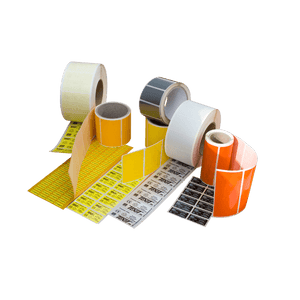
- Self-laminating labels are space-saving, durable (>10 years), easy to apply and protect against external influences thanks to a laminate. They are available for laser printers and thermal transfer printers.
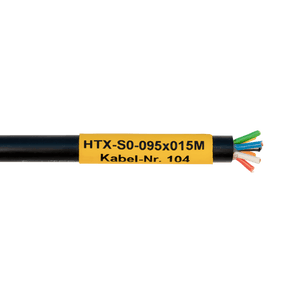
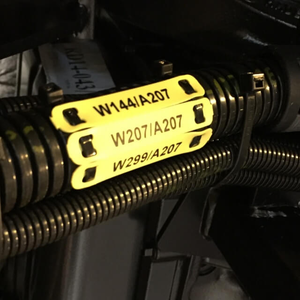
- Cable flags offer more space for information and are particularly suitable for thick cables or extensive labeling.
The table above provides a brief guide to help you choose. For more detailed information about our cable labels, please visit the overview page:
Step 2: Put Together the Right Printing System
Once you've chosen the right cable markers, the next step is to select a printing system.
The printing system consists of:
✓ Texit thermal transfer printer
✓ Compatible ribbon
✓ Texit Designer software
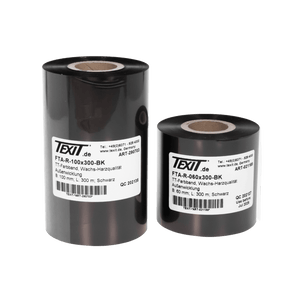
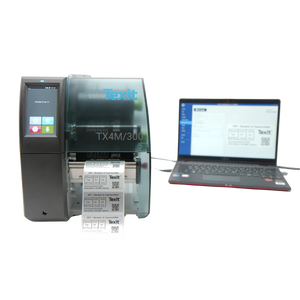
For printing on network cables, we recommend using our TEP5 thermal transfer printer and , if you have chosen a product from our KRT or KFT series, our special resin-based thermal transfer ribbon. To customize the labeling, we recommend using our Texit Designer 11 label software.
Click the button below to request information about the entire KRT-P0 printing system with just one click.
Texit Bestsellers for Patch Cables
Printing System for Labeling Network Cables
Step 3: Print the labels and label the network cables
Once you’ve configured and ordered your printing system, the next step is to create the print design. We’ve developed our Texit Designer 11 software specifically for this purpose. With this easy-to-use software, you can create all your labels on your computer using drag-and-drop. You can design the label flexibly, including numbers for cable IDs or IP addresses. Creating barcodes, logos, or other graphics is also no problem. If you have any questions or need assistance, your dedicated Texit contact person is always available to help.
The last step is the actual labeling of the network cables. Now the printed cable markers just need to be attached to the network cables. As the Texit cable labels already have a permanent acrylic adhesive, all you have to do is carefully peel the labels off the film. Then stick the text field onto the desired location first. Make sure that the label is applied straight. Then wrap the laminate protective film tightly around the cable (preferably a little tighter, as this gives the cleanest result). Congratulations, your network cable is now permanently and legibly labeled!
The procedure is similar for the cable flags. When sticking them to the cables, make sure that the two text fields are neatly glued on top of each other.

Tip for small quantities
Printing Service for Network Cable Labeling
As a time-saving alternative to labeling network cables yourself, you can also have us print the cable labels for you. This not only saves you the time it takes to create the print template and do the printing yourself, but also the cost of purchasing a printing system.
Our experts will advise you—free of charge and with no obligation—on the right material for your application!
Recommendation from our expert Maik on labeling in accordance with standards:

In data centers, only use clear, legible fonts (e.g. Arial or DIN 1451 standards) in sufficient size to ensure legibility even in difficult lighting conditions.
Use a standardized naming convention (e.g., room and port numbers, patch panel labels, power adapters) to facilitate identification and traceability—especially during maintenance or troubleshooting (increases efficiency and speeds up troubleshooting while minimizing downtime).
Document all labels in a central system, ideally digitally, including their assignment to the corresponding ports, patch panels, phones, PCs, and end devices.
When applying adhesive labels, ensure they are positioned away from areas subject to mechanical stress so that the labeling is not damaged by tension, bending, or regular use.
Still have questions about Lan cable labeling? Just get in touch with us!
FAQ: Cable Labeling for Network Cables
What information should be on network cables?
What information should be on network cables?
In order to clearly identify, correctly install and efficiently maintain network cables, two types of information are relevant: technical information from the cable manufacturer and structure-related labeling by the operator or installer.
1. technical cable information (manufacturer's imprint - usually on the cable sheath at the factory):
- Category (CAT): Indicates the performance of the cable, e.g. Cat5e, Cat6, Cat6a, Cat7 - decisive for data rate and bandwidth.
- Shielding: Indicates the protection against electromagnetic interference, e.g. U/UTP, F/UTP, S/FTP.
- Cable length: In practice often specified on a reel, for patch cables usually as a label.
- Cable type: e.g. patch cable (stranded wire), installation cable (solid conductor), LSZH (halogen-free), UV-resistant, etc.
This information is primarily relevant for selection and correct installation - not for system labeling.
2. labeling for the network structure (by the installer):
This is usually done using self-laminating cable labels and contains:
- Cable ID / designation: Alphanumeric and unique in the system.
- Source and destination: E.g. "Rack 01 - Patch panel A - Port 24 → Switch 3 - Port 08".
- Function / service: Such as "VLAN 20", "IP camera", "Access point".
- Date / person responsible (optional): For documentation and traceability.
This structure-related labeling is part of standard-compliant cabling in accordance with e.g. EN 50174, ISO/IEC 14763-2 or ANSI/TIA-606-D.
Who is Texit's network cable labeling suitable for?
Who is Texit's network cable labeling suitable for?
Texit's network cable labeling is suitable for anyone who requires structured, standard-compliant and permanently legible cable identification in IT and network systems. This includes in particular
- Operators and planners of data centers
- IT administrators and network managers
- Electrical and IT installation company
- Facility management and building technology
- Industrial companies with automation networks
- System integrators and service providers
Our labeling solutions meet the requirements of EN 50174 (parts 1-3), ISO/IEC 14763-2 and ANSI/TIA-606-D and support the standard-compliant documentation and maintenance of complex IT infrastructures - from patch cables to backbone cabling.
How can I label patch cables?
How can I label patch cables?
Labels are particularly suitable for labeling patch cables. Care should be taken to ensure that the labels are suitable for cable labeling. Self-laminating cable labels are the most robust.
Thanks to labeling devices, the labels can be permanently labeled quickly and easily and then attached (even to already installed) network cables. The labels can be found as one of the sub-categories of Texit cable labeling.
Does Texit offer simple solutions or labeling devices?
Does Texit offer simple solutions or labeling devices?
In our online store, you can easily select the right cable markers for your IT cabling using a filter or by browsing, and add them to your shopping cart. The shopping cart provides a clear overview of your selected cable identification products (e.g., cable markers or cable labels), as well as information on quantity, item, part number, and the expected delivery time for shipments within Germany.
Request a personalized quote from us quickly and easily—by email, phone, or through our smartphone app!
How can you label patch panels professionally and clearly?
How can you label patch panels professionally and clearly?
To ensure that network documentation remains organized over the long term, patch panels should be labeled clearly, consistently, and legibly. Labels for patch panels are sized appropriately and ensure that individual ports can be clearly identified. Thermal transfer printers produce clean, uniform labels that are particularly well-suited for professional, long-term labeling.
In addition, color-coding using different colors can help you distinguish between network areas (cabinets/servers), functions, or cable types more quickly. This approach significantly simplifies day-to-day work during installation, maintenance, and troubleshooting. It is important that the labeling be unambiguous and consistent so that the connection from the patch panel to the respective connection end can be traced at any time.