




Cable and wire designations such as NYM-J, H07RN-F, H05VV-F, or H05Z1Z1-F contain important information about a wire’s construction, properties, and applications. Designations such as 3G1.5 or 5G2.5 also follow a specific system.
In this overview, we explain the most important cable designations and abbreviations. We also show you how to identify, for example, flexible or halogen-free cables, and why the technical cable designation should not be confused with the individual cable labeling used in machines, systems, data centers, or other technical infrastructures. If you’re interested in learning how to label cables in an electrical installation, you’ll find more information on this topic in our guide of the same name.
| Designation / Symbol | Meaning | Example |
|---|---|---|
| H | harmonized management | H07RN-F |
| 05 | Rated voltage 300/500 V | H05VV-F |
| 07 | Rated voltage 450/750 V | H07RN-F |
| V | PVC material | H05VV-F |
| Z1 | halogen-free thermoplastic blend when used with appropriate harmonized cables | H05Z1Z1-F |
| -F | flexible conductor design | H07RN-F |
| G | Cable with a green-and-yellow ground wire | 3G1.5 |
| X | Cable without a green-and-yellow ground wire | 3 × 1.5 |
| 1,5 | Conductor cross-sectional area in mm² | 3G1.5 |
Important: Not all cable and wire designations follow the same designation system. National wire designations such as NYM-J and harmonized designations such as H07RN-F should therefore be interpreted within their respective systems.
In addition, when selecting a specific cable or wire, the technical documentation, the relevant standards, and the manufacturer’s specifications are always decisive.
Common Cable Designations and Their Typical Uses
In addition to individual letters and numbers, electrical technicians regularly encounter complete cable designations:
| Cable Designation | Typical Applications | Location |
|---|---|---|
| NYM-J | Installation cable with ground wire | Permanent Electrical Installations in Buildings |
| NYY-J | Power cable with ground wire | Permanent installation; under suitable conditions, also outdoors/in the ground |
| H07RN-F | Durable, flexible cable | Industry, workshops, mobile applications, event technology |
| H05Z1Z1-F | Flexible, halogen-free cable | Among other things, areas with stricter requirements for post-fire products |
This overview alone does not provide sufficient information to determine which cable is permissible and suitable for a specific application. To do so, factors such as the environment, electrical load, installation method, and the relevant technical requirements must be taken into account.
Cable Labels FAQ
How do you read a cable label?
How do you read a cable label?
The best way to understand this system is through concrete examples.
Example: H07RN-F 3G1.5
The description can be divided into several sections:
H | 07 | RN | -F | 3G1.5
H = Indicates a harmonized cable.
07 = The number combination 07 stands for the rated voltage of 450/750 V.
RN = The letters in the designation provide information about the insulation and jacket materials used, as well as the cable's construction.
-F = The "F" indicates a flexible conductor design.
3G1.5 = This section describes the wire construction:
- 3 = three wires
- G = including green-and-yellow protective conductor
- 1.5 = nominal cross-sectional area of each conductor: 1.5 mm²
The designation H07RN-F 3G1.5 therefore does not simply refer to “a power cable,” but already provides a range of technical information about the cable.
What does "3G1.5" mean on a cable?
What does "3G1.5" mean on a cable?
The notation 3G1.5 is commonly found on cables and wires. It means:
3 = Number of wires
G = Protective conductor present
1.5 = Conductor cross-sectional area of 1.5 mm²
For example, this means:
5G2.5 = five conductors, including the ground wire, each with a cross-sectional area of 2.5 mm².
If an X appears in place of the G, the specified number of conductors does not include a green-yellow protective conductor.
What does the "X" mean in a cable designation?
What does the "X" mean in a cable designation?
An "X" in this location indicates that there is no green-and-yellow ground wire among the specified wires.
Example:
3 × 1.5 = three conductors without a green-yellow protective conductor, each with a nominal cross-sectional area of 1.5 mm².
The "X" should not be confused with other uses of the letter in other cable designation systems. The key factor is always its position within the complete designation.
Was bedeutet das G bei einer Kabelbezeichnung?
Was bedeutet das G bei einer Kabelbezeichnung?
The "G" in designations such as 3G1.5 or 5G2.5 indicates a cable whose conductor configuration includes a green-yellow ground wire.
Example:
3G1.5 = three conductors, one of which is green-yellow, with a nominal cross-sectional area of 1.5 mm².
How can you tell if a cable is flexible just by looking at its name?
How can you tell if a cable is flexible just by looking at its name?
Anyone looking for a term for flexible cables will often see the letter F at the end of the model number for harmonized cables.
Examples include:
- H05VV-F
- H07RN-F
- H05Z1Z1-F
The "-F" here indicates a flexible conductor design.
A typical flexible cable is, for example, H07RN-F. Such cables are used, among other things, in situations where a rigid installation cable would be unsuitable and the application requires greater cable flexibility.
H05VV-F is also one of the most commonly found types of flexible cable.
Does the "-F" automatically mean that the cable is suitable for any type of movement? No.
The designation of a flexible cable type alone does not necessarily mean that a cable is suitable, for example, for continuous drag-chain movement, torsion, or any other dynamic load. For such applications, the specific manufacturer’s specifications and operating conditions must be taken into account.
What are halogen-free cables called?
What are halogen-free cables called?
When searching for the designation of halogen-free cables, one often comes across the abbreviation Z1 in harmonized cable designations.
For certain harmonized cables, Z1 is an important indicator of halogen-free materials.
However, the question of whether a specific cable meets the requirements for a project should not be answered based solely on a single letter.
Depending on the project, “halogen-free” can, for example, be combined with requirements for:
- Flame resistance
- Smoke development
- Corrosiveness of Fire Gases
- Fire Safety
- CPR Classification
- specific industry or building standards
become relevant.
For this reason, the complete product specifications and the applicable standards or tests are always crucial for planning and selection.
Should halogen-free cables also be labeled as halogen-free?
Should halogen-free cables also be labeled as halogen-free?
If halogen-free cables and wires are intentionally used in a project, corresponding requirements may also be imposed on other materials used.
This could apply, for example, to cable labeling.
Texit offers a variety of labeling solutions made from halogen-free materials. These include, for example, halogen-free heat-shrink tubing markers and halogen-free cable and wire markers.
Important: Whether a specific marking material is suitable for the specific requirements of a project should always be verified based on the technical product specifications.
What does the "F" in H07RN-F stand for?
What does the "F" in H07RN-F stand for?
The "F" indicates that the cable has a flexible conductor design. H07RN-F is therefore marketed as a flexible cable.
Cable Designation vs. Cable Marking: What's the Difference?
In industrial settings in particular, it is important to make a key distinction: The technical cable designation describes the cable. The individual cable marking identifies the specific cable within a system.
Here's an example:
The designation H07RN-F 3G1.5 provides information about the type and characteristics of the cable used.
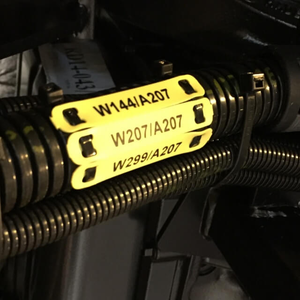
The designation W104 – X2 → M12 , on the other hand, can be used to uniquely identify this specific cable within a machine or system.
In complex technical installations, technical model designations are therefore not sufficient. In such cases, individual cables, wires, and conductors must be clearly identifiable.
You can learn more about the various options in our overview of industrial cable labeling.
What are the options for permanently marking cables?
There are various methods available for industrial cable marking. Which method is appropriate depends, among other things, on when the marking is applied, the size of the cable, and the stresses to which the marking will be exposed.
| Label Type | Typical Application | Can Be Installed Later | Advantages |
|---|---|---|---|
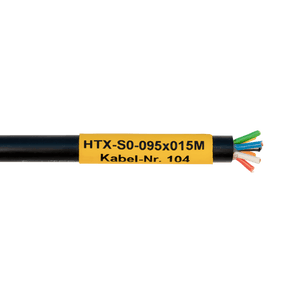
| Cable signs | Industry & Trade, for larger cables or cable bundles, or when a large label area is required | Yes | Large labeling area even on small cables; durable and long-lasting labeling; halogen-free options available |
| Printable heat shrinkable tubing | During cable installation, e.g., in control cabinets or anywhere where extreme stresses are present | No | Extremely durable labeling; takes up little space; available in halogen-free versions |
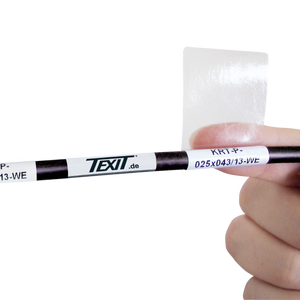
| (Self-laminating) Cable Labels | Industry, Trades, IT & Buildings | Yes | Fast, cost-effective, and flexible labeling. Easy to add labels later, thanks to a durable protective laminate |
| Wire Markers & Cable Clips | Industry, particularly control cabinets and machinery | Depending on the product | For permanent marking of particularly small cables, wires, and individual conductors |
You can find a detailed comparison of the options in our guide , "Marking Cables."
If you're unsure how to label your power cables, our product finder can help.
Which cable label is right for my cable?
If you're unsure which labeling is right for your cables or your specific application, our product finder can help. By answering 4 questions about your labeling needs, our product finder will show you the right products.
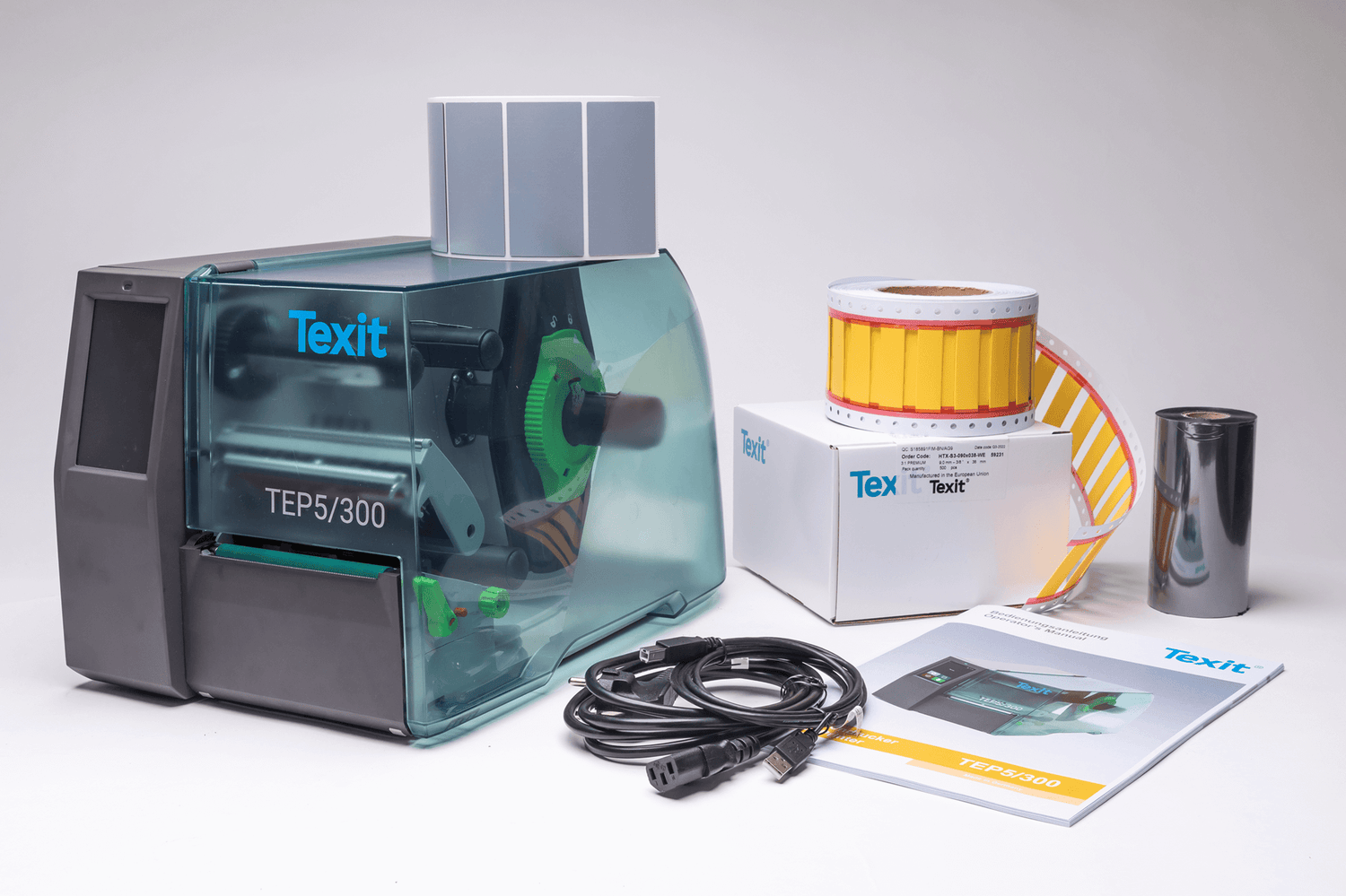
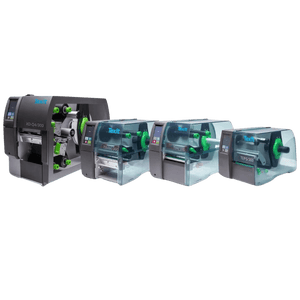
A printing system for cables, machines, and equipment
One advantage of a flexible printing system is that it is not necessary to have a separate printing system for every labeling task.
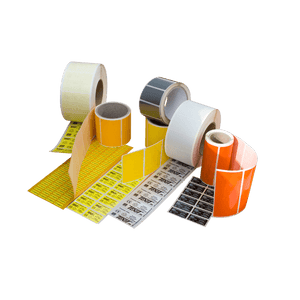
With appropriately selected materials, it is possible to create not only cable labels but also other types of industrial labels, for example:
- Industrial labels
- Nameplates
- Machine Markings
- Component Markings
- Control Cabinet Labeling
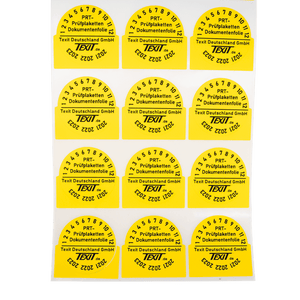
- Test Markings
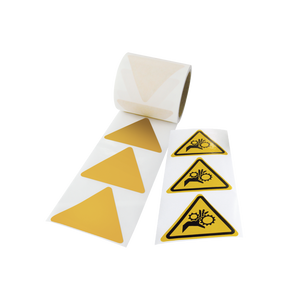
- Safety Instructions
You can find out more about the various applications under " Industrial Marking." There, you'll also find information on suitable marking solutions by industry.